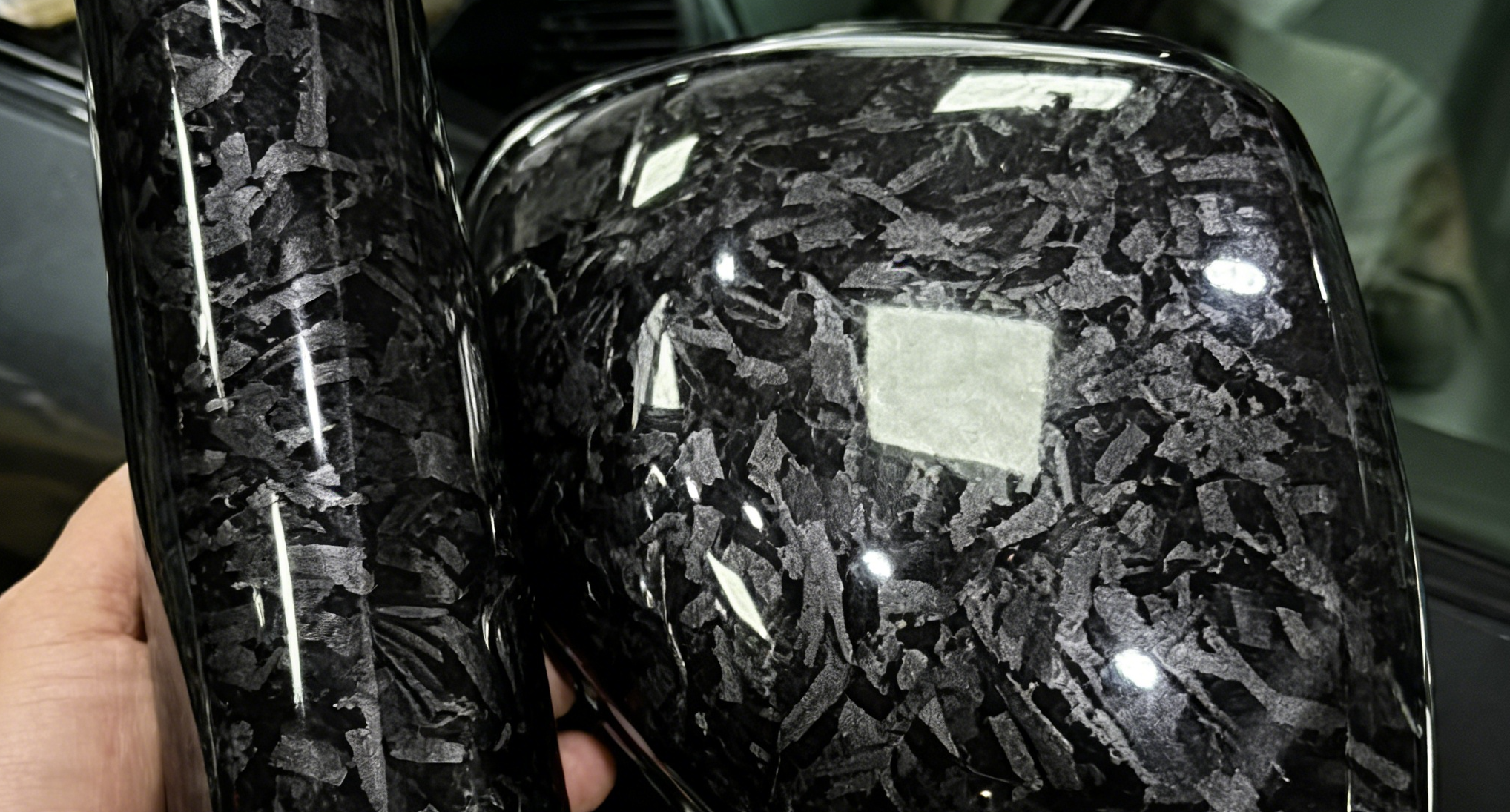
Look at a piece of forged carbon fiber. The first thing you notice: it doesn’t look like the carbon fiber on race cars or luxury laptops. No repeating diagonal weave. No predictable geometric grid. Just a swirling, almost geological pattern that looks truly one-of-a-kind.
That’s not a flaw. That’s the point.
Forged carbon fiber is a different material at its core. It’s built through a different process and carries a different set of strengths. Once you see how it’s made — and why Lamborghini helped push it forward — the performance logic starts to make sense.
Buying, designing, or just curious? This breakdown covers what you actually need to know.
What Is Forged Carbon Fiber?
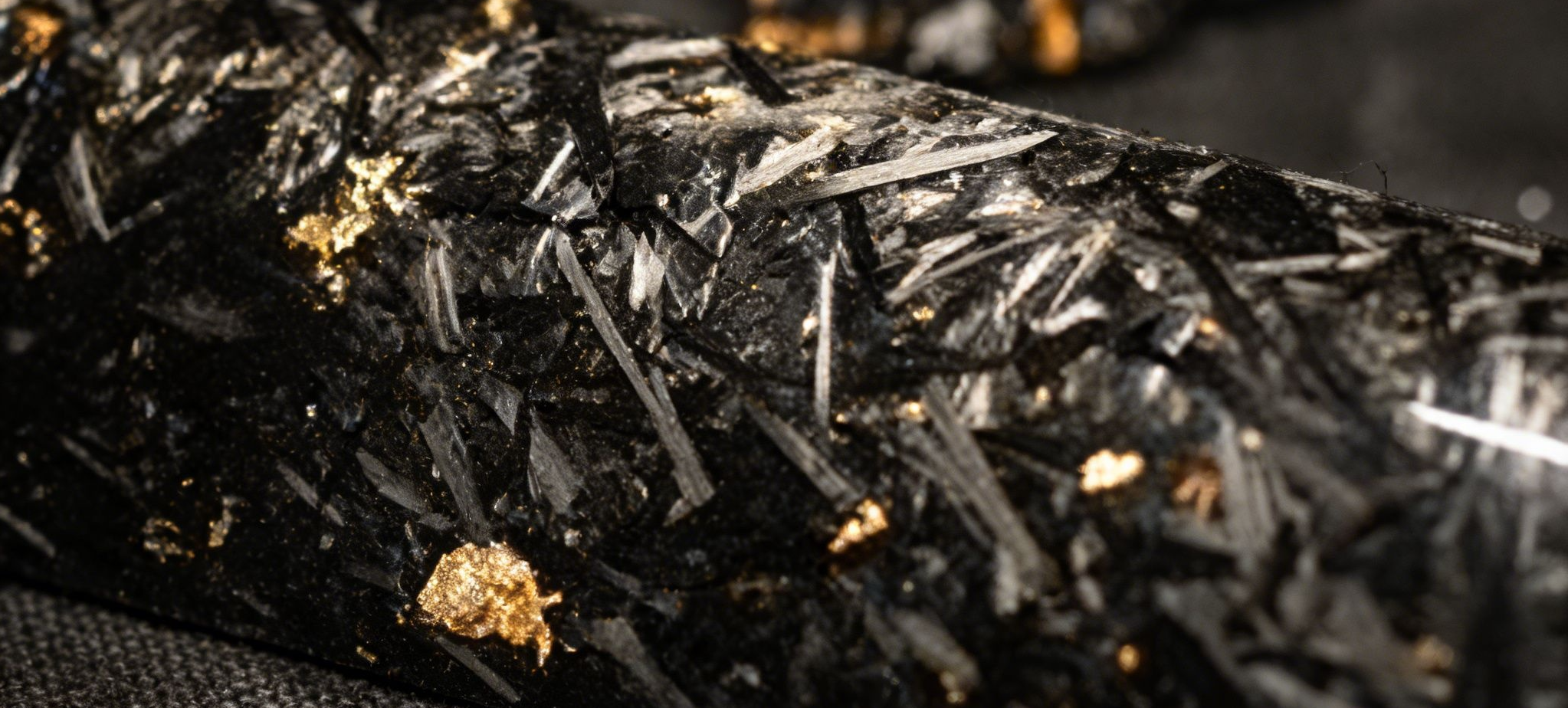
Short carbon fibers. Epoxy resin. A steel mold and serious pressure. That’s the entire recipe — and yet what comes out looks like nothing else in materials science.
Forged carbon fiber (also called forged composite or compression molded carbon fiber) starts with chopped carbon fiber strands cut to less than one inch long. These short fibers mix with epoxy resin — 25% more resin than fiber by weight. They load into a mold in random, unaligned orientations. No careful layup. No precise weave pattern. The randomness is the point.
From there, the mold closes under pressure. Resin flows. Excess escapes through small offsets built into the tooling. The part cures — either at room temperature over 24 hours, or faster under heat in an oven or autoclave.
That compression process creates the swirling, marbled surface pattern forged carbon fiber is known for. Each piece flows in its own direction. No two look the same. The randomized fiber orientation also makes it isotropic — it handles stress from multiple directions. Traditional woven CFRP material is strongest along its fiber axis. Forged carbon fiber doesn’t have that limitation.
You get a high strength lightweight material that performs beyond what it looks like — and looks like nothing else on the market.
How the Randomness Becomes a Feature
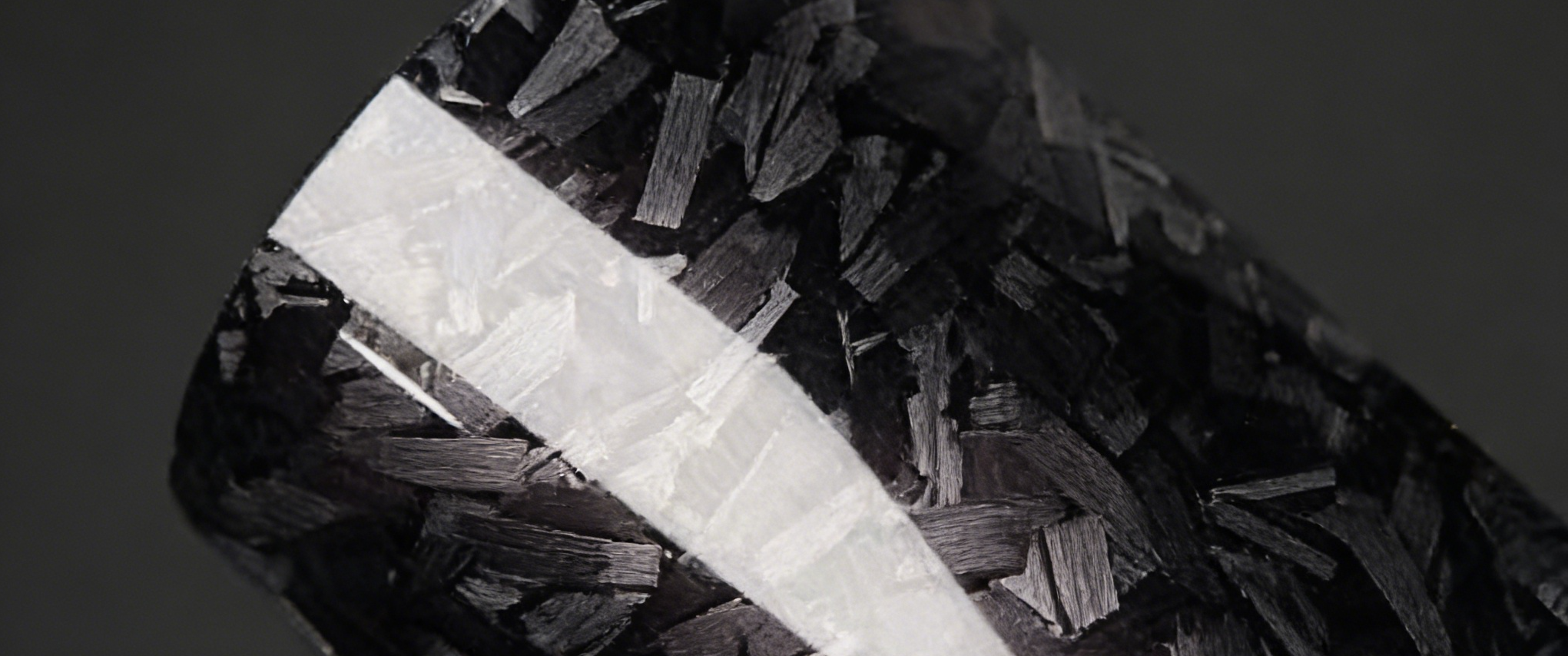
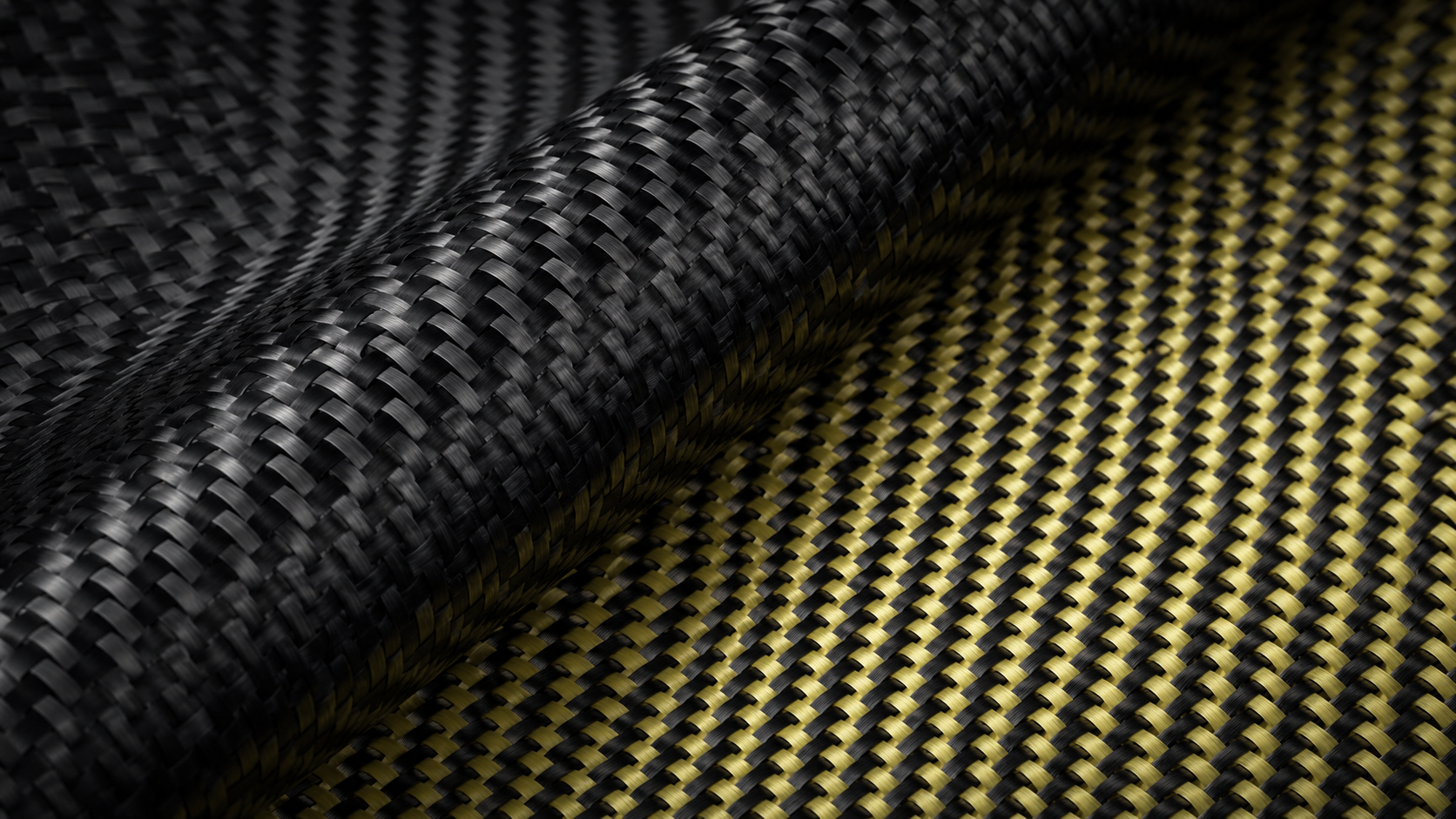
In traditional carbon fiber reinforced polymer (CFRP), fibers get woven into sheets or laid out in specific directions. The goal is to maximize strength along one predictable axis. That approach works well — but it’s rigid. Stress from an unexpected angle can expose its limits.
Forged composite flips that logic. The short strands go into the mold with no preferred alignment. They spread in every direction, which creates what engineers call isotropic properties — strength that doesn’t favor one axis over another. Push it, twist it, load it from the side: you get more consistent performance than woven carbon fiber can deliver.
There’s another practical benefit here. The fiber-resin mixture flows under pressure. So it fills complex mold shapes that continuous woven fiber can’t reach — tight curves, deep pockets, intricate forms that would otherwise need multiple pieces bonded together.
What the Process Involves
The carbon fiber manufacturing process for forged composites runs through five clear steps:
-
Chopping: Carbon fiber tow gets cut into short strands — the raw material that defines this method
-
Mixing: Those chopped fibers blend with resin, with no alignment control applied
-
Molding: The mixture goes into a steel mold, which closes under high pressure and heat
-
Curing: The resin hardens through a chemical reaction — either in an autoclave or a specialized oven
-
Finishing: Trimming, sanding, and polishing bring the part to its final surface quality
Each step is faster and needs less labor than traditional woven layup. You can produce complex shapes without giving up structural strength. That combination is the core reason forged composite technology has moved out of motorsport labs and into watches, consumer electronics, and precision accessories.
Performance Advantages of Forged Carbon Fiber
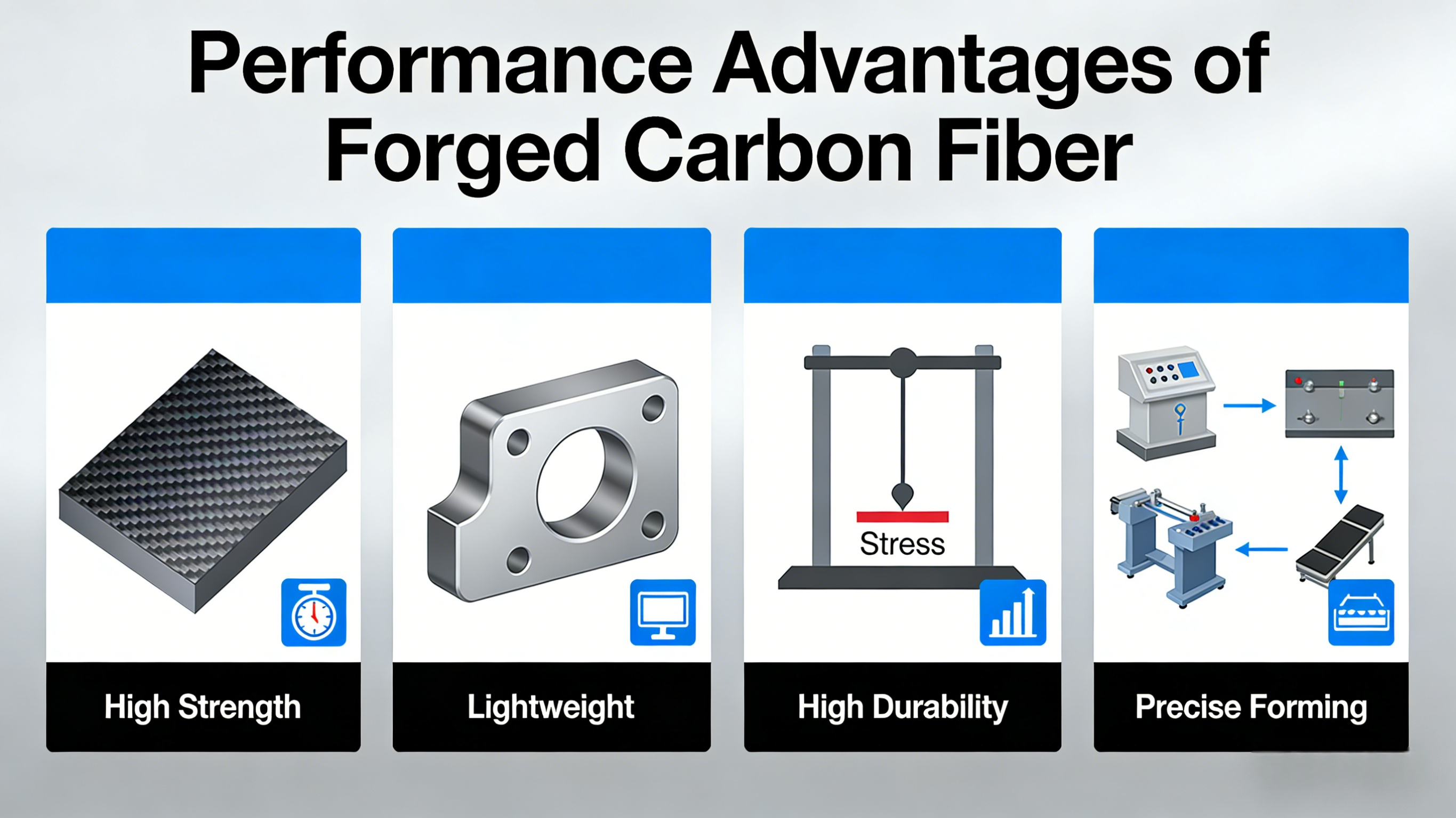
Start with the numbers. In three-point flexural testing, forged carbon fiber held 220 kg of load before failure. Aluminum (6082-T6) failed at 120 kg. That’s close to double the resistance — from a part weighing 24.7g versus aluminum’s 46.7g. The aluminum component was twice as heavy, and it still broke first.
That’s not a marginal gain. It’s a completely different class of material efficiency.
Strength Without the Weight Penalty
Forged carbon fiber’s density sits at 1.5 g/cm³ — 44% less dense than aluminum. Compare that to steel, and the gap grows even more: forged composite runs 70% lighter at similar strength levels.
You can build lighter without building weaker. In lever pull testing, forged carbon yielded at 153 kg versus aluminum’s 98 kg. The forged carbon part was still 47% lighter by actual component weight.
Push further with optimized variants. Integrated continuous fiber reinforcement brings flexural yield up to 268 kg. Tensile strength reaches 875 MPa — far above standard aluminum’s 304 MPa ceiling.
Isotropic Behavior Under Real-World Loads
Random fiber orientation does something woven carbon fiber can’t. It spreads strength in all directions equally. There’s no preferred axis. No hidden weak seam.
A load hits from an unexpected angle — impact, shear, torsion — forged composite handles it. The overlapping random fibers build strong shear and impact resistance. Woven CFRP isn’t built for that kind of multi-directional stress.
Production Speed and Cost Reality
Forged carbon changes what’s possible at scale. A compression-molded part takes minutes. Traditional woven layup takes hours. For manufacturers running volume production, that’s a real difference.
On cost:
– Forged composite runs 20–40% less than woven carbon fiber in mass production
– It costs more than aluminum — 2–3x — but gives you better strength-to-weight in most applications
– Against titanium, the gap is even bigger: forged composite is 5–8x more affordable
One more advantage worth calling out: no corrosion. No coatings needed. No rust, no oxidation, no maintenance cycle.
Limitations and Honest Considerations
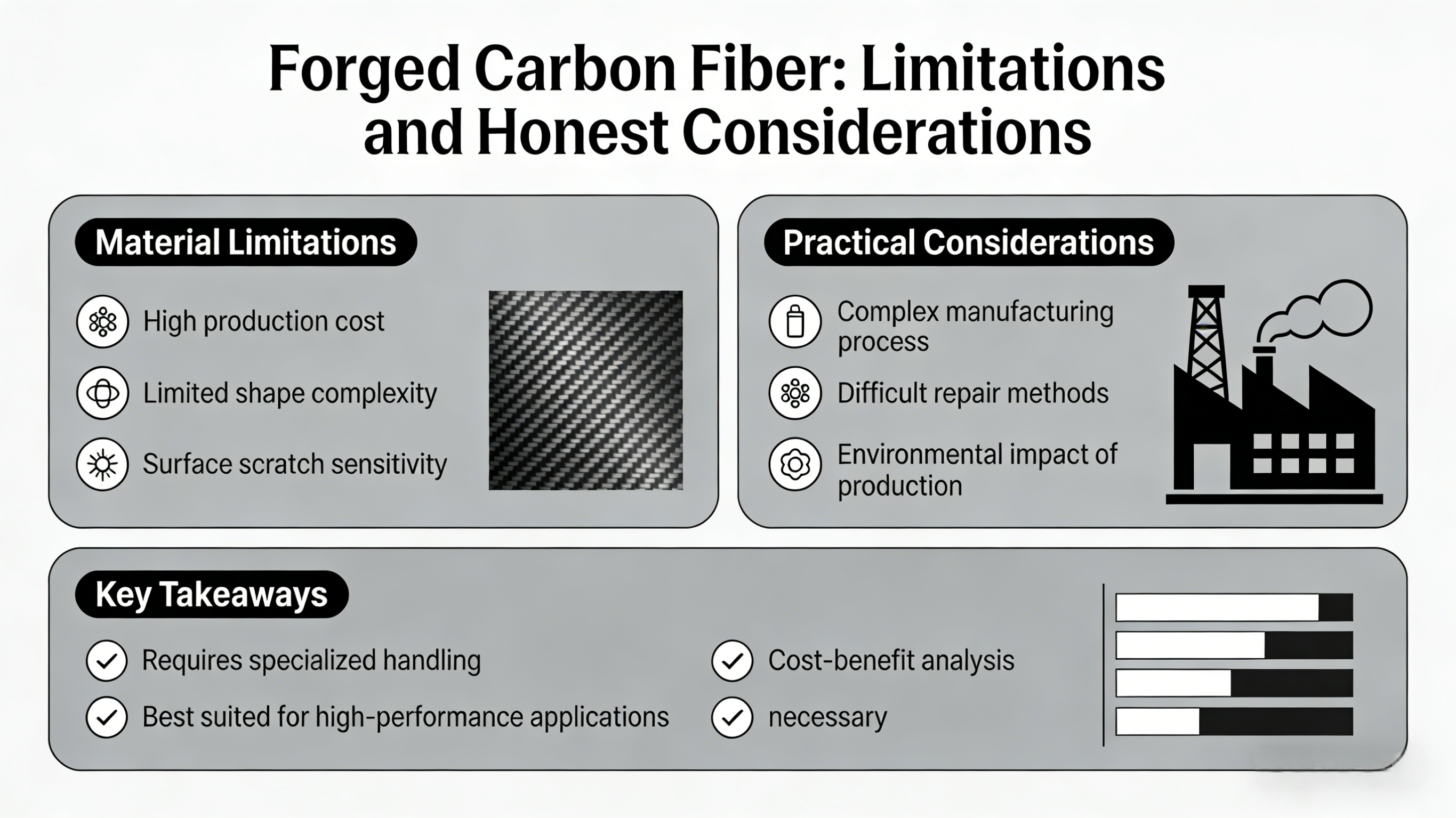
Forged carbon fiber is impressive. But no material is free of tradeoffs, and this one is no different.
The Consistency Gap Is Real
Most product descriptions skip this part. Forged carbon fiber shows a coefficient of variation between 9–19% in mechanical testing. Traditional woven carbon fiber sits closer to 9%. That wider spread comes from the randomized fiber orientation. The same randomness that makes the material isotropic also makes it harder to predict with accuracy.
For a watch case or a phone shell, that variability doesn’t matter. For a load-critical aerospace component or a suspension link with zero tolerance for failure, it does.
Know what you’re buying it for. Forged composite is not a replacement for woven carbon fiber in safety-critical, aerospace-grade applications. It’s a different tool — built for different problems.
Cost Sits Above Aluminum
Forged carbon fiber costs 2–3x more than aluminum at the component level. That price gap is easy to defend — the strength-to-weight ratio holds up in most performance and luxury contexts. Still, it’s a real number. Don’t treat it as a footnote.
The Surface Isn’t for Everyone
The swirling, organic pattern is either the whole point or the wrong call for your project. There’s no uniform weave, no predictable geometry. Designers who need a controlled, repeatable surface look should understand what they’re getting before committing.
This material rewards honest application. Use it where its actual strengths fit, and it delivers. Reach for it where woven carbon or aluminum is the better choice, and you’ll feel the gap right away.
Where Forged Carbon Fiber Is Used: Real-World Applications
Forged carbon fiber started as a Lamborghini engineering experiment. Today, you’ll find it in your car, your watch, and your energy infrastructure. The range is broader than most people expect.
Automotive: Where It Started and Still Dominates
Cars are the biggest consumer of forged composite — 40% of total market share in 2023. The material works well across many parts:
-
Body panels
-
Chassis components
-
Interior trim
-
Under-the-hood parts
Each of these benefits from serious weight reduction. Structural integrity stays intact. Complex curves and tight shapes that used to need multiple bonded woven-carbon pieces? You get them as a single compression-molded component instead. That means fewer failure points, less assembly time, and cleaner design.
Aerospace and Industrial: Serious Performance Territory
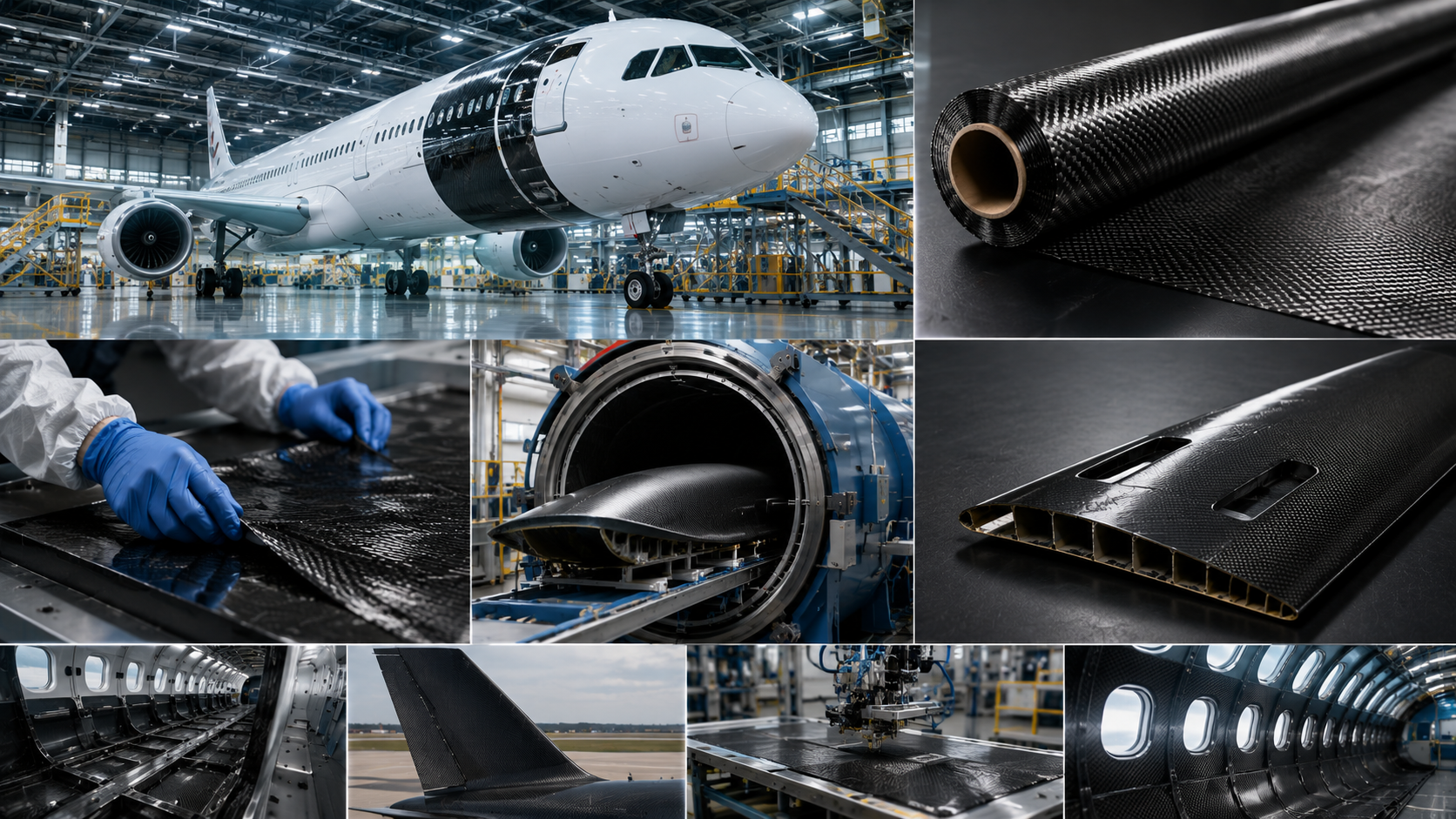
Aerospace makes up 24% of carbon fiber reinforced polymer revenue — and that number is climbing. Forged composite variants show up in:
-
Brackets and ducting
-
Fuselage components
-
Radar-absorbing structures
Lattice-filled brackets built with this technology run 60% lighter than machined aluminum equivalents. On a flight vehicle, every gram counts. That gap is significant.
Industrial tooling is the fastest-growing segment, tracking a 9.1% CAGR. Manufacturers produce jigs, molds, and assembly fixtures on demand. Lead times drop. Speed and precision both improve — you don’t have to trade one for the other.
Consumer and Emerging Applications
For most buyers, sporting goods, consumer electronics, and luxury accessories are the most visible category. Think watches, phone cases, rings, and eyewear. In these products, the swirling surface pattern is the selling point — it’s the feature, not just a side effect.
Further out, the applications get bigger. Hydrogen storage tanks need burst strength above 700 bar. Wind turbine blades stretch beyond 100 meters in length. Forged composite is being tested for both. The market reflects this growth — forged composite demand sits at $134M in 2025, projected to reach $163M by 2030.
How to Identify Authentic Forged Carbon Fiber

Fakes have gotten good. Good enough that a quick glance won’t catch them anymore.
Here’s what separates real forged carbon fiber from a printed wrap or hydro-dip imitation. Most of these tests take less than thirty seconds.
What Your Eyes Should Look For
Real forged carbon fiber has 3D depth. Tilt the piece under light and the fibers appear to shift and move. The swirling marbled pattern bends and changes around edges and curves. That’s because it formed there — it wasn’t printed on top.
Fakes flatten out. Look for repeating tile patterns, visible seams, or a uniform gloss that looks too clean. A plastic-heavy topcoat is a dead giveaway. Real material has no perfect consistency. You’ll feel slight texture where fiber meets resin. There are small irregularities that no vinyl wrap can copy with any accuracy.
Four Fast Physical Tests
-
Tap test: Real forged carbon fiber produces a crisp, high-pitched ping. Fake material sounds dull, hollow, or metallic.
-
Weight test: Real is shockingly light for its size. Feels as heavy as the original metal part? Something’s wrong.
-
Heat test: Hold a hair dryer 2–3 inches away. Real carbon holds up above 500°F with no warping. Fakes melt, bubble, or smell like plastic within seconds.
-
Edge inspection: Flip it over. Real pieces show smooth dark edges and a clean, uniform back — sometimes with tiny frayed fiber tows at cut points. Fakes show yellowish or white fiberglass cores, adhesive backing, or ABS layers underneath.
|
Test |
Real |
Fake |
|---|---|---|
|
Visual pattern |
3D depth, random, distorts on curves |
Flat, repeating, uniform |
|
Tap sound |
Crisp, high-pitched |
Dull or hollow |
|
Weight |
Very light |
Heavy like metal or fiberglass |
|
Edges/back |
Smooth black, clean finish |
White core, adhesive visible |
|
Heat (500°F+) |
No deformation |
Melts, warps, or smells |
|
Surface texture |
Slight fiber-resin feel |
Smooth plastic feel |
A piece that hits every “fake” column? You’re looking at a fiberglass core with a thin carbon overlay on top. That’s a common shortcut used on low-cost automotive hoods and aftermarket accessories.
FAQ: Common Questions About Forged Carbon Fiber
These questions come up all the time. Here are straight answers.
Is forged carbon fiber stronger than regular carbon fiber?
It depends on load direction. Woven carbon fiber performs best in a straight line along its fiber axis. Forged composite handles everything else better. The fibers sit in random directions, which creates strength from every angle — not just one. That’s called isotropic strength. For most real-world uses, that kind of all-around performance is more practical.
How long does it take to make a forged carbon fiber part?
Minutes. That’s the real number. Traditional woven layup takes hours of careful hand work, plus curing time on top of that. Compression molding cuts production time by up to 90%. That speed is a big reason more manufacturers keep choosing this process.
Why does every piece look different?
Short chopped carbon fiber strands go into the mold with zero alignment control. Under pressure, they spread in every direction with no pattern. That movement creates the swirling, marbled surface you see on finished parts. No two pieces land the same way. The pattern doesn’t get printed or applied — it just forms naturally during molding.
Can forged carbon fiber be customized?
Yes — more than most people expect. Manufacturers adjust:
-
Resin formulations to change stiffness or impact resistance
-
Finish types from matte to gloss
-
Color to match brand or design requirements
-
Proprietary fiber blends for unique performance profiles
You can also add continuous fiber reinforcement to specific zones for extra strength in targeted areas. That said, it needs to stay balanced with how the fibers and resin flow during molding — too much reinforcement in one spot and the process breaks down.
Is forged carbon fiber waterproof?
The material doesn’t absorb water. The epoxy resin matrix is sealed and non-porous. No corrosion, no rust, no special coatings needed. That gives it a real edge over aluminum and steel in high-contact or outdoor use cases where moisture exposure is constant.
What are the real limitations?
Two things worth knowing: mechanical variability and cost.
The random fiber layout creates a wider performance spread. You’re looking at a 9–19% coefficient of variation, compared to about 9% for woven carbon. For consumer products and luxury accessories, that range is fine. For aerospace or safety-critical structural parts, it’s a real factor you can’t ignore.
On cost — expect to pay 2–3x more than aluminum. The strength-to-weight ratio makes that worthwhile in most performance contexts. But the price gap is real, and it’s not something to overlook in your budget planning.
Conclusion
Forged carbon fiber isn’t just a material — it’s a manufacturing philosophy. It trades visual perfection for structural freedom. That opens doors traditional woven carbon fiber can’t.
Here’s the key point: compression molded carbon fiber delivers genuine, isotropic strength in complex shapes. Producing those same shapes with standard weave patterns would cost too much — or prove flat-out impossible. That’s not marketing language. That’s physics.
Buying decision or material selection? The answer comes down to application fit. For load-bearing, contoured, high-strength lightweight components, forged composite technology earns its place — every time.
Ready to see it in action? Check out how HyperX Carbon brings forged composite technology into everyday carry pieces. Aerospace-grade material. Objects you’ll touch every day.
The best materials don’t announce themselves. They just perform.
Contact HyperX Carbon – Your Trusted Chinese Carbon Fiber Partner
Ready to source high-performance carbon fiber materials or custom forged carbon fiber parts from China?
HyperX Carbon is a leading manufacturer with 20+ years of expertise, specializing in aerospace-grade forged carbon fiber, prepreg, tubes, sheets, and lightweight automotive/drone/medical components. We offer:
-
Stable supply chain with premium raw materials (Toray, Mitsubishi, Hengshen)
-
AS9100D certified production for aerospace & UAV applications
-
Rapid prototyping (5-8 weeks) and monthly capacity exceeding 180,000 parts
-
Competitive pricing with 15-18% cost savings on forged carbon solutions
-
Full customization: from T700/T1100G to ultra-high modulus grades
Whether you’re an eVTOL developer, automotive OEM, drone manufacturer, or medical device engineer, HyperX delivers consistent quality, batch-to-batch reliability, and reliable delivery.
Get in touch today for a free consultation, custom quote, or material sample.
📧 Email: [email protected]
🌐 Website: https://www.hyperxcarbon.com/
📞 Phone/WhatsApp: +86 15623270276 (English support available)
Let’s build your next lightweight innovation together – contact HyperX Carbon now and stay ahead in the low-altitude and advanced composites market.